
How eco-friendly are leaf plates?
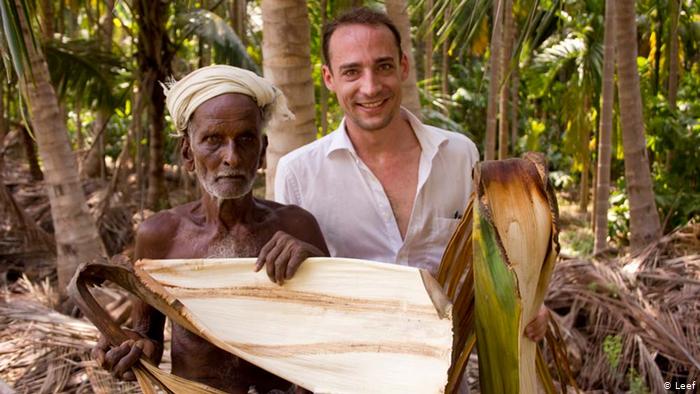
Claudio Fritz-Vietta: For our products, I was drawn from the beginning to India, where they already manufacture products out of these leaves. Once I saw this technique – which is an ancient technique there – I was of course looking at whether there would be any way of producing anything locally, with local leaves in Europe. And unfortunately there is not really any kind of leaf that even comes close to the properties we need.
If you look at the plate, which is nothing more than a single leaf, the leaves are from the areca palm tree that is actually grown for nuts. These nuts are grown on old plantations so there is no forest to be cleared – which is important to say these days – and the leaves are burned in big piles. So they are waste in the first place. And they are just so sturdy, like no leaf in Europe. Almost like wood. When we get them from farmers they are already quite sturdy so we soak them and wash them in a closed-water cycle and then just put the leather-like leaf into a steam press and it press the leaf into the shape we want.
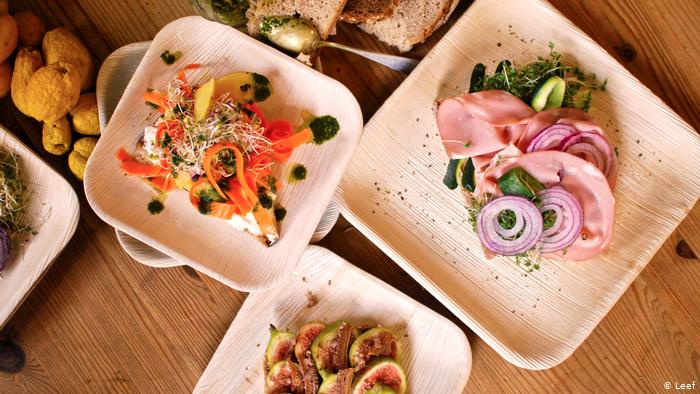
Leef’s biodegradable plates made from recycled areca palm leaves in India
So what is the carbon footprint these leaves leave behind on their trip from India?
The carbon footprint is limited. The ships they are transported on are quite efficient. In our case, it is for a lot of 150,000 plates, which would mean a full container of plastic waste that goes on some landfill in Europe. In order to avoid that, we have the equivalent of truck ride from central Italy to central Germany.
We are confronted with this quite often and I am happy people are critical because it’s necessary in our time. On the other hand, it is not always easy to measure. Any product we buy nowadays – even a yogurt pot, or any paper or plastic plate – makes a much, much longer journey, either imported from China, which is double the distance, or even within Germany, it travels on the road quite a lot. Nobody ever asks how big the carbon footprint of these products is.
Nevertheless we are a “bio” company and we have to live up to this standard. We try to make amends. We buy rainforest for each plate we sell together with the World Land Trust – parcels of rainforest that are on the market to be chopped down. This is our way of making amends because I do share the concerns that this is a bit of a dark spot in the supply chain.
Reference-- Original Link
Testimonials

Adam Smith CEO/Founder Apple